A data centre change can be planned, peer-reviewed and booked into the change window, yet still come down to one engineer typing hundreds of lines into a live switch late at night. One wrong VLAN, one cable in the wrong port, or one BGP setting that doesn't match its neighbour, and nobody knows until the service desk phones start ringing.
In a recent Matrix CNI webinar, we asked HPE what changes when the network can check and fix the network engineer’s work and its own configuration before any changes go live. Joyce Yu, who leads data centre networking sales for HPE in the South Pacific, demonstrated HPE Data Centre Director, formerly Juniper Apstra. Louise Hayward, HPE's regional sales manager for ANZ, showed how Mist and Marvis AI now bring the same intelligence to the data centre that many teams already use on campus and WAN networks.
Here's what they covered, question by question.
Why is data centre networking under so much pressure right now?
Joyce Yu: Data centre networking is more important than ever, mainly because of workload modernisation and the AI workloads that have arrived in force. At the same time, the networks have become larger, more complex and more critical. What we hear from customers is that traditional methods give them limited insight, limited speed and limited ways to keep the network running in the way their workloads need. We've hit the limit of what those old methods can do.
What's actually causing outages?
Joyce: Unfortunately, much of it is due to human error, because so much of the work is still manual. Networks are now too complex to configure line by line or to troubleshoot by hand. We find that around 70% of outages are caused by that kind of manual intervention[1]. So we have to rethink how we run the data centre.
What is HPE's answer?
Joyce: Across the HPE portfolio, our North Star is the self-driving network. This is an intelligent, self-healing network that can identify its own problems and remediate them. In the data centre, we get there with two pieces of software.
- Data Center Director, which came from the Juniper acquisition and which you may know as Apstra, is the controller.
- Data Center Assurance brings Mist’s agentic AI to the data centre.
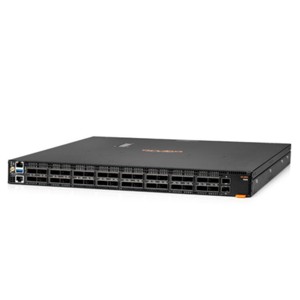
Together with our switching hardware, from out-of-band management ports to 64-port 1.6 Tb switches for AI data centres, that's the self-driving data centre portfolio.
What does "intent-based networking" mean in practice?
Joyce: Traditionally, programming a data centre network meant enabling specific interfaces and configuring specific features. Instead, you start with what you want the network to be. For example, a fabric with two spines and three leaves. That's your intent. Data Center Director combines that intent with best-practice design and tuning, generates the configuration, and applies it to the fabric.
The second half is about keeping that intent true day to day. The running fabric generates a lot of telemetry, which we analyse against the intent we captured. If everything matches, you get green lights. If there's an unexpected change, an outage, or an unusual trend, the system flags it and makes recommendations.
How does it stop a bad change from going live?
Joyce: Because the system understands what's already programmed into the network, it validates every change against that configuration. In the demo, I worked in the "staged" view, a digital twin of the fabric, rather than on the active network. I added a new rack with two leaves, then asked the system to check whether this configuration was correct and whether it would create any errors. Only when there were no build errors did I commit it. Until then, nothing touched the active network.

Changes are built and validated in the staged view (a digital twin) before they’re committed to the active fabric.
If a change doesn't go to plan, Time Voyager keeps a timestamp for every commit, so you can roll back to any earlier state. New fabrics are designed from templates. I built one with two spines and 12 leaves, and the system flagged it straight away when the spines didn't have enough resources for the design.
How does it cut through the noise when something does go wrong?
Joyce: That's the contextual graph database. Because the system knows every object in the network and how they relate, it can correlate problems very quickly. You might see thousands of errors and users unable to reach an application, but tracing it back shows the cause is a single bad optic in one port. Instead of thousands of alerts, the team gets one actionable insight.
What does Data Center Assurance add?
Joyce: It brings all the information from Data Center Director into Mist and Marvis agentic AIOps, giving you cross-domain visibility. You can ask the Marvis agent in plain language why users can't access an application. It draws on documentation, fabric telemetry and historical support cases to identify the root cause.
It also adds predictive maintenance. AI models project the fabric's historical trends forward, showing where errors are likely, with a confidence level and an impact rating. A big, high-likelihood problem that's coming soon is one you fix now, before it causes an outage.
Where does that leave the journey to a self-driving data centre?
Joyce: We're at roughly stage 4.5 of 5. The system already provides insights, recommendations, assistance and predictions. As teams build trust in its suggestions, the final step is to automate more of those recommended workflows.

Many teams know Mist from campus and WAN. Why does it matter for the data centre?
Louise Hayward: Mist is cloud-native and built on microservices from the start. It isn't a management console with AI added later; the telemetry pipeline and models were the starting point. Everything in Mist is measured against service-level expectations, shifting the question from "Is the device up?" to "Is the user or application getting what we promised?" with thresholds you set yourself.
Sitting across all of that is Marvis, an AI engine with more than 10 years of trained models behind it and a conversational assistant. Marvis is now agentic, reasoning across domains, recommending fixes, and, for a growing set of actions, making the change with your approval.
How do Data Center Director and Marvis work together?
Louise: Everything Data Center Director maintains (the contextual graph, the intent, the validation state and the live telemetry) streams into the Mist cloud. Marvis reasons over it, and prescriptive actions and insights are returned.
That means three things. First, the answers are highly specific because the graph has a source of truth in Data Center Director. Marvis isn't guessing your topology because the topology, dependencies and intent are already built in. Second, Marvis Minis can continuously simulate traffic against a digital twin of your fabric, so issues surface before a ticket is raised. Third, data centre issues appear on the same prioritised Marvis Actions list as campus and WAN issues.
What does that look like day to day?
Louise: Marvis Actions is the "morning cup of coffee" view of the network. What Mist does particularly well is eliminate false positives, so you don't see a thousand annoying alerts, only the things that are critical or would optimise the network if fixed. In an ideal world, it would show zero.
In the demo, Joyce showed that the data centre now sits alongside wired, wireless and WAN, with actions to work through. These included incorrect cabling, which is very hard to detect and causes all kinds of issues, a BGP mismatch on leaf 5, and hot and cold interface warnings. Click into any of them and you see exactly where the problem is. This comes with a Data Center Assurance subscription, which brings your Data Center Director information into Mist and the Marvis AI engine.

What's the biggest challenge in bringing new technology into the data centre?
Dion Ryff, Matrix CNI: In our experience, it's multi-vendor data centres. Whether you're consolidating onto a single vendor or keeping a mix, you have to make the integrations work. Many vendors talk about open standards, but that doesn't always hold true. Technologies like this help bridge that gap, reducing the friction of bringing different vendors together, which is where teams spend a lot of time.
Can Data Center Director run a mixed-vendor fabric?
Joyce: Yes. Before any of the acquisitions, Apstra was built to be completely vendor-agnostic. Intent-based networking is about what you want the fabric to be logically, not about how a single vendor configures it. That multi-vendor core has been maintained now that it's part of HPE. It works very well with HPE's own switching range, and we'll continue to bring other vendors' hardware into the system, so you can design, deploy and operate the same way across all of it.
Where is this heading?
Louise: Self-driving networks are already past the talking stage. The platform already fixes certain issues with your approval. At HPE Discover in June, we announced that it will predict hardware and optics failures in the data centre before they occur, using a root-cause agent trained on millions of real support cases.
More of the work will be done for you, but in stages. First, it tells you what needs doing, then recommends exactly what to do and waits for your sign-off before acting. Eventually, it just does it and reports back. That's safe rather than scary because, as Joyce showed, the system already knows what the network is supposed to look like and can roll back.
"Automation you can't undo is a bad idea. But this isn't that." — Louise Hayward, HPE
Watch the demos >
The full session includes Joyce's live walkthrough of Data Center Director and Louise's tour of Marvis Actions for the data centre. Because Data Center Director is vendor-agnostic, it's worth a look even if your racks today aren't HPE.
To talk through how this would apply to your own environment, contact Matrix CNI and one of our engineers will be in touch.